Peter Sobota retires
The beloved professor looks back on his career

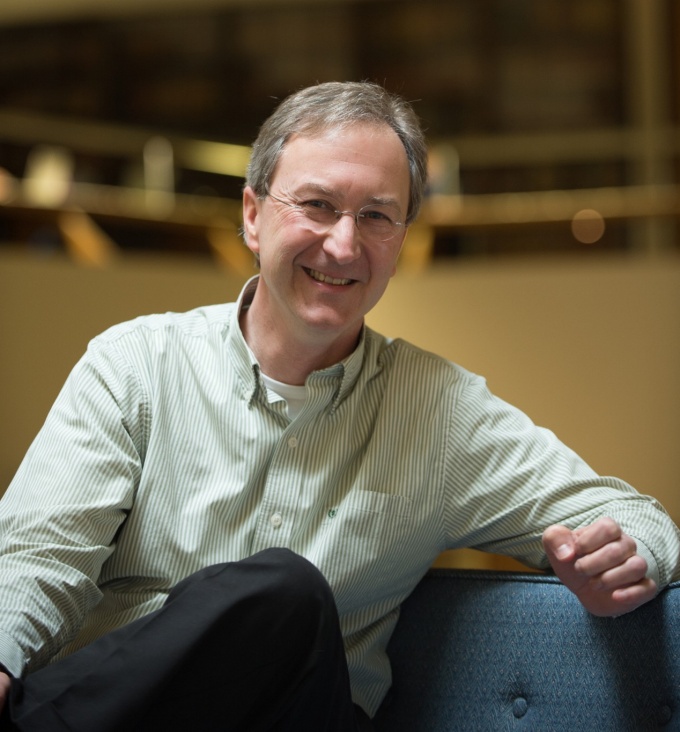
Photo: Onion Studio
By Matthew Biddle
After 25 years on the School of Social Work faculty, Peter Sobota will retire this spring.
An alumnus himself with a BA and MSW from UB, Sobota has taught countless students on topics ranging from interventions, trauma and human rights to motivational interviewing and civic engagement. He has been honored three times with the student-voted Outstanding Faculty Teaching Award.
Sobota is also the longtime host of the school’s podcast, inSocialWork®.
Before he packs his office, Sobota sat down to reflect on his career and what he learned along the way.
Tell us your origin story as a social worker. Why did you go into this profession?
Peter Sobota: I’ve always been kind of rebellious or contrary, and that helped me see how the world didn’t work for a lot of people, including people I knew. I grew up in a working-class neighborhood, where we were free-range — our parents worked, so when we came home it was mayhem. People would see me doing something foolish 12 blocks away and let my parents know; I didn’t like it at the time, but it kept me out of trouble and showed how important community can be.
Once I got to UB, I felt lucky to be in college. This was my opportunity to learn, so I read everything and did everything. Social work fit with the idea that I could make a living and still be consistent with my values. Forty-one years later, I have no regrets. I’m retiring, but I’m not counting down the days.
After working in practice, why did you return to UB to teach?
PS: Well, that wasn’t planned, but in hindsight it all makes sense. After I graduated, I did a lot of clinical work but eventually realized that systemic issues that maintain problems would keep individual clients in a never-ending supply. So, I wanted to intervene at community and organizational levels to be more efficient and try to change systems.
I lucked my way into a job at the Postal Service, where I did consulting around workplace behavior. I wasn’t doing traditional social work, but I would talk about attachment theory or trauma or systems theory — without using those terms — and people listened and implemented changes. After that, I did similar work at Motorola for five years — and then Motorola imploded. I was friends with [emeritus faculty member] Charles Syms, who said the school was looking for another clinical faculty. I needed a job, so I applied. It was totally serendipitous.

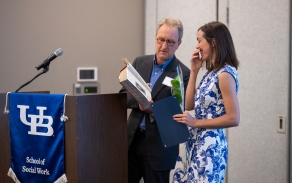
Sobota nominated Cate Bearss, MSW ’22, for the National Association of Social Workers Award, and at the ceremony, presented her with a dictionary with her picture pasted under “social worker.” Photo: Onion Studio

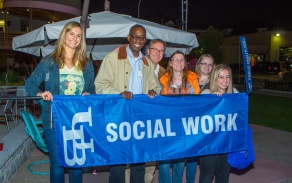
Sobota and Charles Syms, emeritus faculty member, reconnect with alumni at a UB event at Larkinville.
What will you miss most when you retire?
PS: I’ve enjoyed living in a world of ideas with smart, like-minded faculty and staff. It’s the ultimate example of lifelong learning. How many jobs pay you to read and learn new stuff?
Social work students are incredibly open, and I’ve appreciated the students who’ve given me constructive feedback and made me a better instructor and a more well-rounded person in many ways.
Many are so bright that I just can’t wait to see what they do once they get out in the field. And then, they’ll contact me 10 years later, telling me about something I said in class that they still think about — that makes you want to come to work the next day.
What do you hope students have learned from you?
PS: I’ve tried to promote freedom of thought and to question the status quo, including what you’re learning about while you’re learning it.
I also want students to understand that the only limit to what they can do as social workers is themselves. I have a former student who went into school social work and built the social work program at a new charter school. Now, she is an assistant principal.
I don’t understand why more social workers don’t become administrators or journalists or organizational consultants. As a practitioner, I probably did the most useful work at the Postal Service and Motorola because I helped people keep their jobs so they could raise their kids and pay off their house. I was an advocate, a broker. I felt incredibly useful and could never have planned that.
What will you remember about hosting our inSocialWork podcast?
PS: I’ve loved pursuing my interests and finding all kinds of experts — not just social workers but also physicians, attorneys, activists, people who espouse social work values.
For one episode, I remember reading a letter to the editor in The New Yorker that struck me, so I called her up. She was a journalist, but in her spare time, she went to raves and did harm reduction, helping people test their drugs before they went in. She was doing a practical form of service in an open-minded way, and it was fascinating. I’ve loved meeting people like that and giving them a chance to showcase what they know or do.
How has the profession changed during your career, and where should it go from here?
PS: I’ve had a 41-year lovers’ quarrel with social work, in that I’m proud to be a social worker, but we are almost always our own worst enemy. When social work went searching for status and better salaries, we hooked ourselves to clinical work and licensure — and those have been good things. We’re now the largest providers of behavioral and mental health services in the country. But we hitched our wagon so exclusively to that medical model that we got away from some of our roots.
It’s encouraging that more students want to work on systems at the macro level because social work is under attack. We’re living in interesting times, and if we’re not part of the solution, shame on us. We’ve got to advocate and accumulate power and influence — and don’t apologize for it. A return to radical social work would not be a bad idea right now.