
Service to country — and community
By Devon Dams-O’Connor
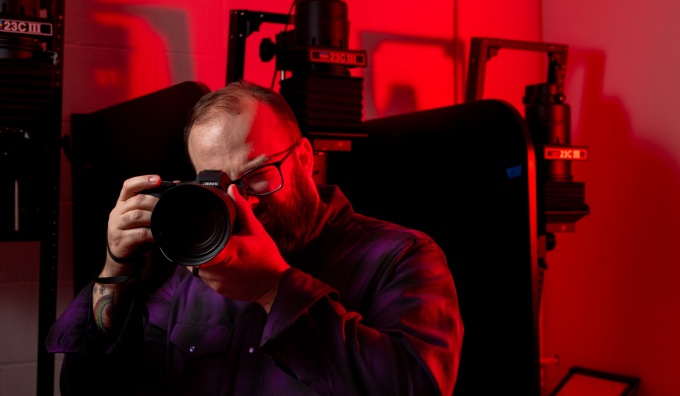
What do the military, photography and social work have in common? Quite a bit, according to Rob Healy, a UB MSW student and combat veteran who found support and a second career through photography.
Service first
When Healy says he comes from a military family, it’s not a term he uses lightly. Both of his grandfathers served, and so did his father, brother, aunt, uncle and five cousins in his generation alone. His family’s duty lineage stretches back to the American Revolution.
Healy was a military brat who grew up on bases, where the value of service was of the utmost importance. A central tenet of the Healy house was simple: If you have the ability do good, you have the obligation to do good.
Healy enlisted in the U.S. Air Force Reserves at 17 while pursuing his undergraduate degree at UB and spent nine years as an airman in air operations and logistics — or, as he puts it, “FedEx with guns.” He was deployed three times between semesters, to Kyrgyzstan in 2006, Iraq in 2008 and Kuwait from 2009-2010. His work required acute attention to detail in dangerous situations, like rigging parachutes for air drops in combat zones.
Photography brought me back to myself. It made me more present in my interactions and forced me to slow down, observe, pause and appreciate.


MSW student Rob Healy. Healy portraits by Meredith Forrest Kulwicki.
Life through a different lens
We’re proud to showcase MSW student Rob Healy’s artwork in this story. Far left, son, Lucas pictured reading with his grandmother. Middle is a self-portrait of Healy. Above far right, he and his son, Lucas, worked together on this double exposure to convey the feeling of detachment that many veterans feel upon returning from deployment.
Healy’s first camera was a Canon Rebel 35mm that he bought with deployment money. That camera was destroyed during deployment, and Healy let photography go for about a decade.
When he finally picked up another camera, it was to calm what was behind the lens more than to capture what was in front of it.
In 2019, Healy was feeling numb, apathetic and stuck in a job that didn’t give him purpose — a stark contrast to the structure and mission of military life. Then, he found the Odyssey Project, an intensive, 12-week photography workshop to help veterans reintegrate to civilian life and find connection, creativity and healing through photography. Three months into Odyssey, Healy began to feel differently.
“Photography brought me back to myself,” he explains. “It made me more present in my interactions and forced me to slow down, observe, pause and appreciate. The group wasn’t about the losses, tragedies or trauma we all experienced — it was more about belly laughs and noticing the little things.”
He began working on a photography project with his son, who was five years old and learning to navigate the world with mild cerebral palsy. Together, they documented his mobility journey, experimented with double exposure and got a little silly enjoying time together.
The workshop culminated in an exhibition that remains the group’s most-attended show to date.
Afterward, Healy continued as a peer mentor with the program, which received funding to host a second workshop and provide a camera for every participant to keep. More veterans heard about Odyssey and wanted in — including Healy’s father. Sessions scheduled until 9 p.m. ran to midnight, as members bonded over shared pasts and current projects.
For many, says Healy, the club was the only place veterans could surround themselves with people who understood complex military experiences without explanation.
“Sometimes it felt like being back in a unit — with the same horrible jokes,” says Healy.
Healy’s work often explores themes of family, trauma and the transition to civilian life. Lucas is Healy’s “anchor to the world.” In the cyanotype print on left, Healy captures the challenge of opening himself up to bond with his son while letting in the pain of the past. And for the photo on the right, Healy says, “Many Buffalonians associate the Peace Bridge with home, but Joining Forces-UB and the Veterans and Military Family Focus program felt like home when I enrolled.”
The path to purpose
Through Odyssey, Healy realized the impact he could have working with people and began a new mission toward a different type of service.
With help from the U.S. Department of Veterans Affairs’ Veteran Readiness and Employment program, which provides career counseling and covers educational expenses, Healy enrolled in the School of Social Work’s Master of Social Work program. His goal is to become a social worker who serves veterans and their caregivers to offer the support many veterans don’t have.
“When my family gets together for a holiday, everyone is military and it’s basically a VFW pop-up,” explains Healy. “Not everyone has this level of support, being surrounded by people who know the lingo, the lifestyle and the experiences, so I try to create it everywhere I go.”
A few weeks into classes, Healy met Dan Ryan, director of Veterans Services at UB, who casually mentioned that he wished an MSW student could implement opportunities like Odyssey for UB veterans — not knowing Healy was an MSW student himself. Healy joined UB Veterans Services as its first MSW intern for his foundation year practicum.
Healy adds a social work perspective to everything the office does. He’s developing a cultural competency training program for civilians who work with veterans in education and health care. He’s working on new services for student veterans on campus, like counselors who can offer support during exams and other stressors. While continuing to run photography workshops, Healy represents UB at local veterans’ events, networks with similar offices at nearby schools and helps first-year student veterans acclimate to life at UB.
One of those students happens to be a familiar face from Odyssey — a veteran, like Healy, who found clarity through photography and chose to pursue a new purpose at UB.
At left, son Lucas walks with red balloons and a T-shirt on a black-and-white canvas. At right, MSW student Gabby Kirsh models Kintsugi, a Japanese art form of repairing “broken” things to make them beautiful.