
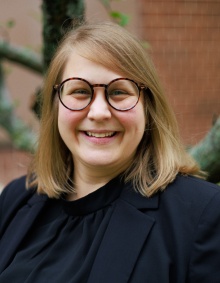
Kathryn Miller-Procknal
Clinical Assistant Professor
Pronouns: she/her
“I am deeply passionate about providing high-quality, evidence-based practices to individuals and families experiencing mental health or behavioral health challenges. This work includes service to individuals experiencing co-occurring mental health diagnosis and intellectual/developmental disabilities.”
Education
- DSW, Social Work, Simmons University (2025)
- MS, Applied Behavior Analysis, Daemen University (2021)
- MSW, Social Work, University of Albany (2015)
- BA, Social Work, Daemen University (2014)
Professional/Research Interests
Dialectical Behavior Therapy; trauma-informed care; intellectual and developmental disabilities; autism spectrum disorder; suicide prevention and intervention strategies; analysis of higher education practices
Biography
Kathryn (Kat) Miller-Procknal is a clinical assistant professor in the University at Buffalo School of Social Work. She is clinically trained in Cognitive Behavioral Therapy (CBT), Comprehensive Dialectical Behavior Therapy (DBT) and Trauma-Focused Cognitive Behavioral Therapy (TF-CBT).
Miller-Procknal has experience in individual, group and family therapy. She teaches or has taught courses in social work interventions with children, adults, families, groups and communities; suicide prevention and intervention strategies; evidence-based practice; and diversity.
Miller-Procknal continues to engage in clinical practice, primarily with individuals and families in a small private practice. She has experience in community mental health, residential treatment, outpatient services and crisis prevention and intervention. Her clinical and research interests include working with individuals diagnosed with intellectual and developmental disabilities and co-occurring mental health conditions; DBT; suicide prevention, intervention and postvention strategies; and radical/critical social work teaching practices.