![Meet Rachel Daws, MPH/MSW '17 [1:35 min]](http://img.youtube.com/vi/tJ5d81p2bkA/mqdefault.jpg)
MPH/MSW Dual Degree

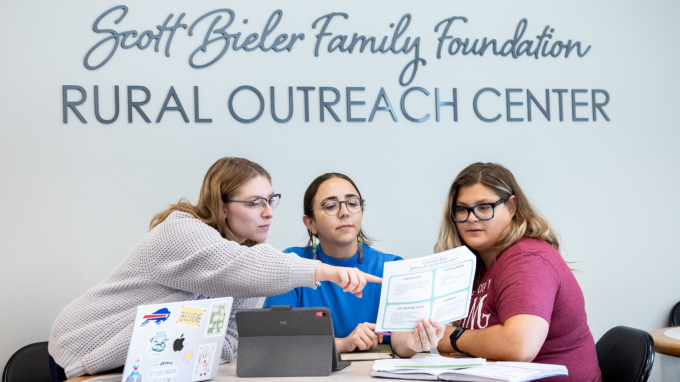
2024 Social Impact Fellows working with the Scott Bieler Family Foundation Rural Outreach Center identified gaps in public transportation that mobile health clinics could address.
Through UB’s Master of Public Health/Master of Social Work (MPH/MSW) program, you will be trained to improve equity and health outcomes by working directly with individuals and at the community level.
With an MPH/MSW degree, you will incorporate a public health perspective into social work practice to address health disparities and create change in individuals’ lives and health care policy. By earning both degrees simultaneously, you will be prepared for an impactful career, with a broader understanding of the factors that influence health across populations.
Our curriculum statement articulates our commitment to the promotion of social justice, the protection of human rights and the necessity of addressing structural oppression and inequities in power and resources.
Our MPH/MSW program enables you to earn both a Master in Public Health (MPH) and a Master of Social Work (MSW). This collaborative program with the UB School of Public Health and Health Professions reduces the amount of time and credits compared to completing both programs separately. While there is a reduction in total credit hours for the dual degree program, you must meet all other requirements for both degree programs.
We offer two MPH/MSW programs: Traditional and Advanced Standing.
Both MPH/MSW course of study options are full time and on campus only and incorporate our signature trauma-informed and human rights perspectives.
As part of the MPH/MSW, you have two concentration options for public health:
- Health Systems Administration explores how to assess population health needs, formulate policies and interventions, and assure the effectiveness of community programs and services.
- Community Health and Health Behavior explores the actions of individuals, groups and organizations from a scientific perspective to promote health.
Traditional MPH/MSW program
- For students with a bachelor’s degree in any undergraduate major
- 900 total practicum hours (420-hour foundation practicum + 480-hour advanced year practicum)
- Full time (3 years) and on campus only
- Students have the option to begin the program either in the School of Social Work or in the School of Public Health and Health Professions. The first and second years of courses will reflect the order in which you choose to complete MSW and MPH requirements.
This curriculum is effective fall 2024. If you started your MSW program prior to fall 2024, please follow the curriculum listed in the Student Handbook for the year in which you began your program.
First Year
Fall Semester
SW 500 Social Welfare History
SW 505 Theories of Human Behavior and Development
SW 510 Introduction to Social Work Research and Evaluation
SW 520 Interventions I
SW 550 Practicum Instruction I
SW 555 Practicum Seminar (0.5 credit)
Spring Semester
SW 502 Social Welfare Policy
SW 503 Diversity and Oppression
SW 506 Theories of Organizational Behavior and Development
SW 521 Interventions II
SW 551 Practicum Instruction II (4 credits)
SW 555 Practicum Seminar (0.5 credit)
Second Year
Fall Semester
EEH 530 Introduction to Health Care Organization*
CHB 501 Study of Health Behavior*
STA 527 Statistical Analysis I (4 cr.)
EEH 536 Health Policy in the United States
EEH 590 Leadership, Collaboration and Negotiation in Public Health (2 cr.)
Spring Semester
EEH 500 Intro to Epidemiology
EEH 550 Environmental Health
EEH 532 Financial Management for Public Health Professionals
EEH 538 Introduction to Health Economics
CHB 507 Public Health Teams and Practice (2 cr.)
Third Year
Fall Semester
SW 542 Perspectives on Trauma and Human Rights*
SW 552 Practicum Instruction III, 4 credits
Advanced Topic - SW 570 Health and Disability Social Work*
Advanced Interventions - SW 531 Crisis Interventions*
MPH Elective
Spring Semester
SW 553 Practicum Instruction IV*
Advanced Topic (choose one)
SW Elective (choose one)
EEH 630 Culminating Project
MPH Elective
*These courses count towards the degree requirements for both the MPH and MSW degrees. All students must take CHB 501, EEH 530, SW 542, and 6 additional credits of qualifying courses (SW 570, SW 531, SW 553). If using your MSW practicum (SW 553) towards your MPH requirements, it is your responsibility to ensure that your MSW practicum satisfies the MPH internship requirements, and you would need to take either SW 531 OR SW 570 in addition. If you choose NOT to share your practicum training experience between your MPH and MSW, or it does not qualify, you must take both SW 531 AND SW 570. These classes would count toward your MSW Advanced Interventions and Advanced Topics requirements, respectively.
First Year
Fall Semester
SW 500 Social Welfare History
SW 505 Theories of Human Behavior and Development
SW 510 Introduction to Social Work Research and Evaluation
SW 520 Interventions I
SW 550 Practicum Instruction I
SW 555 Practicum Seminar (0.5 credit)
Spring Semester
SW 502 Social Welfare Policy
SW 503 Diversity and Oppression
SW 506 Theories of Organizational Behavior and Development
SW 521 Interventions II
SW 551 Practicum Instruction II (4 credits)
SW 555 Practicum Seminar (0.5 credit)
Second Year
Fall Semester
CHB 501 Study of Health Behavior*
EEH 530 Introduction to Health Care Organization*
STA 527 Statistical Analysis I (4 cr.)
CHB 525 Health Equity
EEH 590 Leadership, Collaboration and Negotiation in Public Health (2 cr.)
Spring Semester
EEH 500 Intro to Epidemiology
EEH 550 Environmental Health
CHB 505 Applied Statistics for Public Health
CHB 507 Public Health Teams and Practice (2 cr.)
CHB 502 Health Behavior Change
Third Year
Fall Semester
SW 542 Perspectives on Trauma and Human Rights*
SW 552 Practicum Instruction III, 4 credits
Advanced Topic - SW 570 Health and Disability Social Work*
Advanced Interventions - SW 531 Crisis Interventions*
CHB 523 Program Planning & Evaluation
Spring Semester
SW 553 Practicum Instruction IV*
Advanced Topic (choose one)
SW Elective (choose one)
CHB 630 Culminating Project
MPH Elective
*These courses count towards the degree requirements for both the MPH and MSW degrees. All students must take CHB 501, EEH 530, SW 542, and 6 additional credits of qualifying courses (SW 570, SW 531, SW 553). If using your MSW practicum (SW 553) towards your MPH requirements, it is your responsibility to ensure that your MSW practicum satisfies the MPH internship requirements, and you would need to take either SW 531 OR SW 570 in addition. If you choose NOT to share your practicum training experience between your MPH and MSW, or it does not qualify, you must take both SW 531 AND SW 570. These classes would count toward your MSW Advanced Interventions and Advanced Topics requirements, respectively.
Loading...
With an MPH/MSW degree, you will be well-positioned for roles that require an understanding of population health, social determinants of health and trauma-informed practice. This dual perspective supports careers focused on improving access to care and strengthening communities through evidence-based interventions and advocacy.
Potential MPH/MSW Careers
As a graduates of our dual MPH/MSW program, you can pursue careers in a variety of public health, social service and policy-oriented settings. Depending on your professional interests and area of focus, potential career paths may include:
- Public health program coordinator or manager
- Community health or population health specialist
- Health services administrator
- Social worker in healthcare or public health settings
- Health equity or prevention specialist
- Roles within government agencies, nonprofits or community-based organizations
With the flexibility of the MPH/MSW program, you can adapt your training to diverse roles that address health and social challenges at both the individual and population levels.
MPH/MSW students will be billed the full-time MPH tuition rate during the semesters they are only taking MPH courses, and the full-time MSW rate when they are only taking MSW courses.
During semesters in which students take coursework from both departments, the full-time tuition rate of the school in which the student has registered for the majority of their credits will be used.


